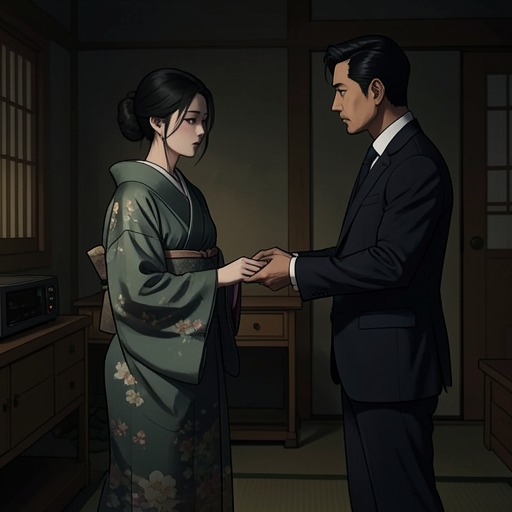
Destiny and agency
Memoirs of a GeishaIn Memoirs of a Geisha, destiny and agency are not simple opposites: Sayuri experiences her life as shaped by bonds and circumstances she cannot escape, while those around her insist that she still bears responsibility for how she moves within them. The tension becomes acute when Nobu’s offer to become her danna threatens the future she has imagined with the Chairman. Mameha calls their bond an en, a connection lasting a lifetime; Nobu, in turn, argues that Sayuri’s position gives her influence she must use. The novel leaves the boundary between fate and choice unsettled, making it both a source of pressure and a means by which Sayuri interprets her changing life.
Destiny as an Uncertain Future
Sayuri’s fear begins when Mother treats Nobu’s proposal as a business decision and says that only a fool would pass up his offer. Sayuri has reason to see it coming: Nobu had bid for her mizuage years earlier and had sought her company more often than any other man. Yet anticipation is not acceptance. She had never believed that becoming his mistress would actually be the course her life took, because it would close off her hopes concerning the Chairman. The distinction between foreseeing a possibility and believing it inevitable gives the dilemma its force: the offer seems to fit the pattern of her past, but accepting it would still mean surrendering a future she wants.
Sayuri connects this crisis to the almanac reading she received on first meeting Nobu at a sumo tournament: “A balance of good and bad can open the door to destiny.” Looking back, she sees the good and bad as intertwined with the people and events that shaped her: Mameha and Hatsumomo, her adoption by Mother and her mizuage, and the Chairman and Nobu. Destiny in this account is not a clean reward for virtue or punishment for error. It emerges from mixed circumstances, where relationships that help open one path may also bring Sayuri to a painful crossroads.
Mameha refuses to promise that Sayuri’s imagined future will come true. She points to Shizue, a geisha whose thirty-year relationship with a pharmacist brought the two companionship despite his lack of wealth and her lack of beauty. Shizue’s life suggests one possible form of good fortune, but Mameha tells Sayuri that neither of them can know what her destiny will be, and she may never know it. Destiny may not arrive as a satisfying resolution; it may amount to struggling through life from day to day. When Sayuri protests that this is cruel, Mameha agrees, adding that none of them can escape destiny. Her counsel gives no assurance that the future will reward Sayuri’s longing; it asks her to live without that assurance.
The Bond with Nobu
The word en gives Sayuri a way to understand why Nobu remains present in her life, even when she does not wish to accept the future he offers. Mameha tells her that she and Nobu have an en and cannot escape it. Sayuri already recognizes the bond: in her understanding, an en is a karmic connection lasting a lifetime, and Nobu’s touch has left a deeper impression on her than most people’s. She cannot know whether he will be her ultimate destiny, but she senses that he will always have a place somewhere in the landscape of her life.
That recognition does not erase the personal cost of the bond. Sayuri asks herself whether she will have to put away every hope so completely that neither anyone else nor she herself can see them again. Her fear is not merely that she will have to accept Nobu; it is that accepting one relationship may make the futures she has dreamed of inaccessible. Mameha answers by returning Sayuri to work, telling her to prepare for the evening ahead and suggesting that work is the best way to get over a disappointment. The practical instruction does not resolve the question of destiny. It shows how, within the life of a geisha, an overwhelming private uncertainty is followed by the obligations of the next engagement.
Influence Within Constraint
Nobu’s later argument complicates any interpretation of Sayuri as simply carried along by events. He tells her that, as Mother’s adopted daughter and the daughter of the okiya, she cannot pretend to have no influence. It is her duty to use what influence she has; otherwise, he warns, she risks drifting through life like a fish belly-up on a stream. Sayuri wishes she could believe that life is more than a current carrying her, but Nobu distinguishes between controlling the stream and choosing where within it to be. His image preserves constraint while making room for a limited, consequential agency.
Nobu’s rebuke is rooted in his judgment of Sayuri’s choice to tie her fortunes to General Tottori. He believes he would have taken proper care of her and is furious that she has chosen a man who, when he is gone, will leave her with nothing to remember him by. He calls her decision a waste of her youth and says that a woman who acts like a fool is a fool. His words make agency painful rather than triumphant: Sayuri’s ability to choose does not guarantee a wise or safe outcome, and Nobu’s own claim to know what would have been best for her is colored by his disappointment and desire to have been chosen.
The scene also recalls Nobu’s earlier recognition of Sayuri’s resourcefulness. He says that when he first saw her at the sumo tournament, years before, he could see what a resourceful girl she was. That remembered judgment sits against his later accusation that she does not understand where her destiny lies. The contrast does not settle whether Sayuri has acted freely or mistakenly. Instead, it shows how a quality Nobu once admired becomes, in his eyes, a failure when her decisions do not align with the future he wanted for her.
The Limits of Choice
The novel’s account of agency remains bounded by the world in which Sayuri lives. Mameha tells her that geisha do not become geisha because they expect satisfying lives, but because they have no other choice. The claim sets a severe limit on any celebration of individual freedom: Sayuri can hope, interpret, and maneuver, but those acts occur within a life whose available paths are sharply constrained. Her longing for the Chairman and the pressure of Nobu’s proposal cannot be treated as choices made on an open field.
At the same time, Sayuri’s sense of en prevents constraint from becoming mere passivity. The people who have touched her leave lasting impressions, and her life is formed through connections she cannot simply erase. Nobu’s influence, Mother’s decisions, and the events that brought Sayuri to her present position become part of the pattern through which she reads her future. Fate is therefore neither wholly external nor wholly self-authored: it is experienced in relationships, remembered as a sequence of good and bad turns, and confronted through choices that carry real consequences.
Destiny and agency remain unresolved because the novel gives each a persuasive voice. Mameha speaks of an unknowable future and an inescapable bond; Nobu insists that Sayuri’s influence makes action her duty; Sayuri feels the current of events while continuing to hope for a life beyond the path others consider sensible. The tension does not promise that agency can defeat circumstance. It asks instead how a person can choose within a life already shaped by other people—and whether the bonds that constrain a future may also be what give it meaning.